
Table of Contents
- Soft Wash vs Pressure Washing: Key Differences Explained
- Comparison Table: Soft Washing vs Pressure Washing
- Why Pressure Washing Can Damage Your Roof
- The Best Eco Friendly Roof Moss Killer for Safe Cleaning
- How Often Should You Clean Your Roof?
- Roof Cleaning Safety Standards and Regulations
- DIY vs Professional Roof Cleaning: Risks and Costs
- Environmental Impact and Roof Warranty Considerations
- Frequently Asked Questions
Last Updated: September 15, 2026
Soft Wash vs Pressure Washing: Key Differences Explained
The choice between soft wash roof cleaning vs pressure washing comes down to one principle: roofs need chemistry, not force. Soft washing removes organic growth with low-pressure solutions, while pressure washing relies on mechanical force that strips protective layers from tiles and shingles. This guide covers when each method applies and how to protect your roof warranty.
Soft washing operates under 500 PSI, treating mould, algae and lichen at the root with biodegradable solutions. Pressure washing uses 2,000 PSI or more, and on a roof, that force is the problem.
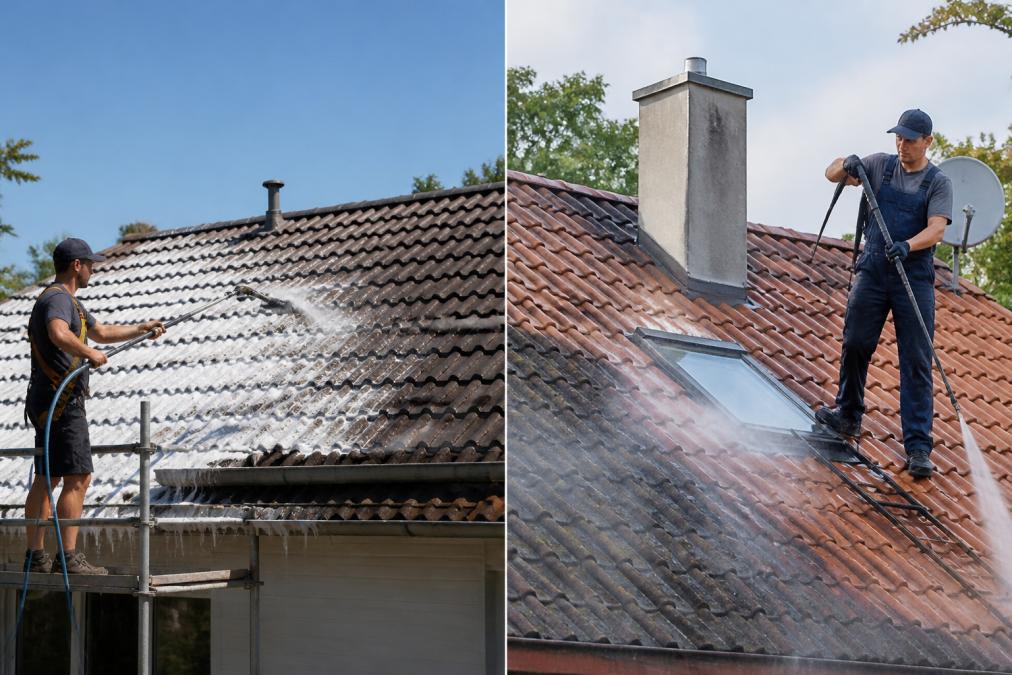
What Is Soft Washing?
Soft washing is a low-pressure method that applies biodegradable solutions to kill mould, algae and lichen at the root, then rinses without mechanical force. It uses roughly one-third the water of pressure washing, and results last four to six times longer because spores are eradicated rather than displaced.
What Is Pressure Washing?
Pressure washing uses mechanical force, often through adjustable nozzles, to strip dirt from hard surfaces like driveways and concrete. On roofs, those settings abrade tiles, dislodge shingle granules and force water under flashing.
Comparison Table: Soft Washing vs Pressure Washing
| Factor | Soft Washing | Pressure Washing |
|---|---|---|
| Pressure used | Low (under 500 PSI) | High (2,000+ PSI) |
| Method | Chemical cleaning agents | Mechanical force |
| Best for | Roof tiles, delicate surfaces | Driveways, concrete |
| Mould and lichen | Root level treatment | Surface removal only |
| Water consumption | Low | High |
| Roof integrity risk | Minimal | Significant |
| Result lifespan | Four to six times longer | Shorter, growth returns |
Why Pressure Washing Can Damage Your Roof
High pressure destroys roofs in ways that are not obvious until months later, and the damage is cumulative.
Surface Abrasion and Shingle Granule Loss
Shingle granules and tile glazing form the roof’s protective coating. High pressure strips them away, exposing the material beneath to UV, rain and corrosion, the roof ages years in one session.
Mould, Algae and Lichen: The Real Problem
Mould spores and algae embed in the porous surface of tiles and shingles. Pressure washing removes visible growth but leaves spores behind, so regrowth appears within months. Soft washing kills spores at the root, so results last longer.
Never let a contractor pressure wash a tiled or shingle roof. The visible result looks clean for a few weeks, then granule loss and water ingress show up as leaks and premature roof replacement.
The Best Eco Friendly Roof Moss Killer for Safe Cleaning
There is no single “best” moss killer, the right choice depends on your roof material, the severity of growth, and how runoff will be managed. What separates a safe eco-friendly treatment from a damaging one is the active ingredient, concentration, surfactant and application method, not the brand.
Active ingredients and what they actually do
- Sodium hypochlorite (diluted), the workhorse of soft washing. At roof-safe dilutions it oxidises mould, algae and lichen at the root. Fast-acting but non-selective: it bleaches plants and harms aquatic life if it reaches a garden bed or stormwater drain untreated.
- Quaternary ammonium compounds (quats), slower-acting but longer residual, often blended with sodium hypochlorite. Quats bind to the surface and keep killing spores for weeks.
- Peroxygen-based treatments, gentler for metal roofs and painted surfaces where hypochlorite may accelerate corrosion or fade coatings. Slower, but lower risk to landscaping.
- Surfactants, not a killer on their own, but they break water’s surface tension so the active ingredient penetrates the moss root rather than beading off. Without one, a treatment mostly runs off.
Dilution and application
Concentration is where most DIY jobs go wrong. A mix strong enough to strip a concrete driveway will etch tile glazing and dull Colorbond; a garden-safe mix may not kill established lichen in one pass. Most professionals use a sodium hypochlorite solution for routine maintenance, adjusted for growth and surface sensitivity.
Application method matters as much as the mix:
- Downstream injection draws the chemical into the water stream after the pump, so it reaches the roof at low pressure, the standard professional setup.
- Water-fed pole systems let the operator apply and rinse from ground level, removing the fall risk and giving more even coverage than a ladder-and-sprayer.
- Pump-up sprayers are workable for small areas but slow, and the operator still has to be on the roof.
Apply soft wash solution on an overcast day with no rain forecast for at least 24 hours. Direct sun dries the solution before it penetrates the moss root, and you end up repeating the job. Wind above roughly 15 km/h also causes drift onto garden beds and neighbouring properties.
Managing runoff, the part most guides skip
Every chemical you put on a roof eventually leaves it, and where it goes is regulated. Under the federal Environment Protection and Biodiversity Conservation Act 1999 and state legislation, it is an offence to allow polluted water into a stormwater system (Environment Protection and Biodiversity Conservation Act 1999). Stormwater in most urban areas discharges to creeks, rivers and bays untreated, so a roof wash that flows into the street drain flows into the local waterway.
Practical containment options:
- Pre-wet and post-wet garden beds with plain water to dilute overspray.
- Divert downpipes into a lawn or garden area rather than the stormwater inlet, where soil and vegetation filter the runoff.
- Block the stormwater grate with a temporary barrier and pump the water onto a permeable surface, or arrange trade waste disposal for large volumes.
- Choose the mildest effective treatment for the growth level, rather than defaulting to the strongest mix.
Some councils require a trade waste agreement or environmental management plan for commercial roof cleaning. A professional operator will know which applies and carry the containment equipment to comply.
Never wash roof cleaning chemicals directly into a stormwater drain. In most jurisdictions this is a breach of environment protection legislation, and the fine applies to the homeowner who commissioned the work as well as the operator who performed it.
Matching the treatment to the roof material
- Terracotta and concrete tiles, hypochlorite-based soft wash is standard. Avoid acid-based cleaners, which etch the surface.
- Colorbond and zincalume steel, use peroxygen or quat-based treatment; hypochlorite accelerates corrosion on cut edges and fasteners.
- Concrete and terracotta shingles, soft wash only. Pressure washing dislodges the surface layer and shortens service life.
- Asphalt shingles, soft wash only, and check the manufacturer’s cleaning specification first, because many warranties exclude pressure washing outright.
If unsure which treatment suits your roof, ask the manufacturer or a roofing supplier what they recommend.
How Often Should You Clean Your Roof?
Roof Cleaning Safety Standards and Regulations
Work health and safety obligations
For roof cleaning, the practical requirements are:
Environmental protection and runoff
Environment protection penalties can apply to the property owner who commissioned the work, not just the operator who performed it. If a contractor washes chemicals into the stormwater drain on your property, you can be exposed to the fine.
Roof warranty implications
What to check before any clean:
Insurance and liability for DIY
The safest and most warranty-friendly approach is a low-pressure soft wash applied by a qualified operator, with runoff contained and disposed of in line with state environment protection legislation. It removes the fall risk, protects the roof surface, and preserves the manufacturer’s warranty.
DIY vs Professional Roof Cleaning: Risks and Costs
| Scenario | DIY | Professional |
|---|---|---|
| Equipment cost | High (purchase or hire) | Included |
| Fall risk | Serious | Managed |
| Warranty protection | At risk | Preserved |
| Results | Variable | Consistent |
| Environmental compliance | Your responsibility | Handled |
Environmental Impact and Roof Warranty Considerations
Frequently Asked Questions
Is soft washing better than pressure washing for roof tiles?
Soft washing is generally safer for roof tiles because it uses low pressure and biodegradable solutions to kill mould and algae at the root. Pressure washing can force water under tiles and strip protective coatings, leading to leaks and corrosion. Soft washing also lasts four to six times longer than pressure washing according to industry data.
How long does soft washing a roof last compared to pressure washing?
Soft washing typically lasts longer than pressure washing. This is because soft washing kills mould spores and algae at the root, while pressure washing only removes surface growth. With soft washing, you can expect results to last several years, reducing the need for frequent cleaning.
Can pressure washing damage roof tiles or shingles?
Yes, pressure washing can cause significant damage. High pressure can strip shingle granules, crack tiles, and force water underneath, leading to leaks and corrosion. It can also void roof warranties. Soft washing avoids these risks by using low pressure and chemical cleaning agents that are safe for delicate surfaces.
What is the best eco friendly roof moss killer?
The best eco-friendly roof moss killer is a biodegradable solution that uses surfactants and sodium hypochlorite at low concentrations to kill moss, algae, and lichen without harming the environment. These solutions are applied at low pressure and break down safely. Always check that the product is approved for use on your roof type and follow safety protocols.
Do you rinse the roof after soft washing?
Yes, after applying the soft wash solution, the roof is typically rinsed with low pressure to remove dead organic matter and residual chemicals. Rinsing ensures a clean finish and prevents any potential damage to plants or surfaces below. The rinse also helps the solution penetrate and kill spores at the root level.
Roof cleaning is not a job where the cheapest quote wins. The wrong method costs you a roof. Jet Wash Cleaning provides soft wash roof cleaning, moss and algae removal, gutter clearing and solar panel cleaning using water-fed pole systems and eco-friendly methods, so your roof is treated correctly the first time. Get a free quote from Jet Wash Cleaning and protect your roof with a clean that lasts.